Selecting an External Fixation Device is a clinical and commercial decision, not a simple catalogue exercise. Global buyers must compare frame design, pin configuration, radiolucency, adjustment range, and sterilization requirements. The right system should support fracture stability while respecting soft-tissue conditions. It must also fit the surgeon’s technique, hospital resources, and regional procurement standards.
Dr. Gavriil Ilizarov, a pioneer of circular fixation, stated, “The main goal of treatment is to restore the function of the limb.” This principle remains practical today. A ring fixator may suit complex fractures or gradual correction. A unilateral frame may offer faster application and easier access to the wound. Hybrid systems can balance stability with reduced bulk. Modular frames support revision when the clinical picture changes.
Details matter. Pin coatings, clamp strength, carbon-fiber bars, and scale markings affect daily use. A small design weakness can become a repeated operating-room problem. Buyers should review clinical evidence, manufacturer quality systems, traceability, and post-sale technical support. Regulatory clearance must be checked in each target market. One approval does not guarantee global acceptance.
This guide compares ten major External Fixation Device types for international buyers. It considers typical indications, advantages, limitations, and purchasing questions. The categories are useful, but not perfect. Device boundaries sometimes overlap. Product names can also hide meaningful differences. Careful evaluation remains essential, especially when patient anatomy, surgeon experience, and hospital workflow vary. A lower purchase price may look attractive. Yet training needs, replacement parts, and complication management can change the true cost.
External Fixation Devices: Definition, Structure, and Classification
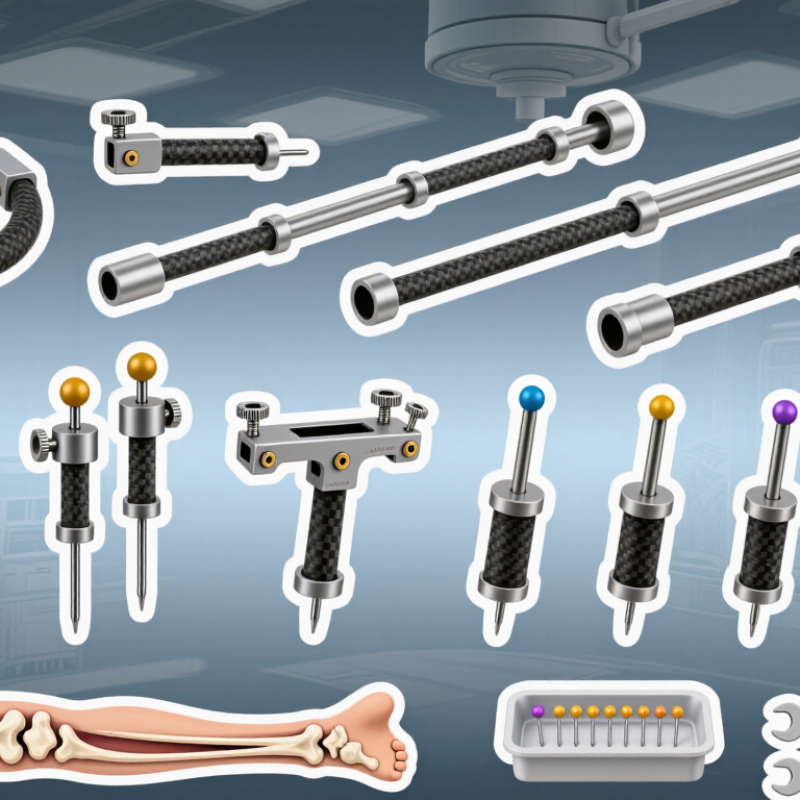
External fixation devices stabilize fractured or damaged bone outside the body. Their basic structure includes fixation pins or wires, clamps, connecting rods, rings, hinges, and locking joints. Pins enter the bone, while rods or rings create an external load-bearing frame. Carbon-fiber rods reduce weight and improve imaging visibility. Stainless steel and titanium components offer different balances of strength, stiffness, and corrosion resistance.
A practical classification identifies ten common types:
unilateral frames, bilateral frames, circular ring fixators, hexapod systems, hybrid frames, hinged fixators, spanning frames, mini fixators, pediatric frames, and bone-transport systems. Unilateral frames use one side-mounted bar and are relatively quick to apply. Circular and hexapod systems distribute forces around the limb, often supporting complex deformity correction. Spanning frames cross a joint temporarily, while hinged systems permit controlled movement. The categories overlap. That matters.
Grand View Research’s 2024 market analysis projected steady growth in external fixation systems through 2030, supported by trauma treatment and reconstructive procedures. Fortune Business Insights also identified hospitals and trauma centers as major demand settings in its recent orthopedic devices report. Buyers should examine pin diameter, radiolucency, clamp adjustment, frame stiffness, sterilization compatibility, and spare-part availability. A lighter frame is not automatically better. Clinical teams still need secure purchase in poor-quality bone, accurate alignment, and manageable pin-site care. Even experienced users can overvalue modularity; more adjustment options may increase training demands and assembly errors.
Unilateral, Bilateral, and Monolateral Rail Fixators
Top 10 External Fixation Device Types for Global Buyers
Unilateral, Bilateral, and Monolateral Rail Fixators
External fixation systems support fracture stabilization when soft-tissue access, swelling, or staged treatment matters. Global buyers should compare structure, adjustment range, pin options, and documentation.
Unilateral fixators place the frame mainly on one side of the limb. They are often practical for straightforward alignment and easier wound access.
Bilateral fixators use supports on opposite sides, improving frame stiffness in selected complex injuries. However, they can restrict access and demand careful positioning.
Monolateral rail fixators use a rail with adjustable clamps and pins. Their sliding design can support controlled compression, distraction, or gradual alignment changes. In clinical practice, rail stiffness depends on rail size, pin spread, clamp security, and bone quality. A compact frame is not always the best frame.
Buyers should request material specifications, sterilization information, mechanical test data, and clear assembly instructions. Check whether the system supports local surgical workflows and training levels. Regulatory expectations also differ across markets, so verification should involve qualified medical-device professionals.
Fit matters more than a long component list.
Some decisions remain imperfect. A lighter frame may improve handling but reduce stability in demanding cases. A highly adjustable system may increase setup time and user error. Clinical teams should test representative configurations, review supplier reliability, and document feedback from actual procedures. Availability of replacement clamps and compatible pins also deserves attention, especially in regions with longer supply cycles.
Circular Ring, Hybrid, and Taylor Spatial Frame Systems
Circular ring external fixators support complex limb reconstruction, especially when stability must surround the bone. Their full rings distribute forces across several fixation points. Surgeons can adjust alignment while monitoring swelling, wound condition, and bone healing. Wire tension matters. Poorly tensioned wires may reduce stability or irritate soft tissue.
Hybrid frames
combine a ring near the joint with half-pins along the shaft. This design can improve access around knees, ankles, or injured soft tissue. It may also shorten operating time in selected cases. However, hybrid systems require careful pin placement and frame planning. A compact frame is not automatically a better frame.
Taylor spatial frame systems use adjustable struts and imaging-based planning to manage angular, translational, and rotational deformities. They can support gradual correction, but accurate measurements remain essential. Small planning errors can create noticeable alignment changes. Clinicians should verify radiographs, patient tolerance, and adjustment instructions throughout treatment.
Global buyers
should examine material traceability, sterilization compatibility, radiographic visibility, and training support. Regulatory documentation must match the destination market. Compatibility between rings, struts, wires, and pins also deserves close review. The difficult part is often not purchasing the frame. It is ensuring the clinical team can apply and adjust it safely. No system fits every patient. Device selection should reflect anatomy, soft-tissue conditions, surgeon experience, and follow-up capacity.
Global Buyer Criteria: Applications, Standards, and Supplier Selection
Global buyers should match external fixation device types to anatomy, injury pattern, and treatment setting. Common options include unilateral, bilateral, circular, hybrid, spanning, articulated, mini, pediatric, foot-and-ankle, and emergency damage-control systems. Unilateral frames suit many long-bone fractures and provide efficient bedside adjustment. Circular and hybrid frames support complex alignment, bone transport, and gradual correction. Spanning frames can stabilize unstable joints temporarily, but they may restrict movement and complicate nursing care.
Supplier evaluation requires more than a low quoted price. Review technical files, material specifications, sterilization information, and batch traceability. Relevant evidence may include ISO 13485 quality systems, ISO 14971 risk management, and biocompatibility testing under ISO 10993, where applicable. Confirm the product’s regulatory status in each target market. Ask whether the supplier provides surgical training, application guides, replacement parts, and responsive complaint handling. A strong supplier should explain pin compatibility, clamp torque, radiolucent access, and expected lead times clearly. Vague answers are a warning sign.
Tips: Request sample documentation before ordering. Compare frame assembly time using a realistic fracture scenario. Check packaging after simulated transport and storage. Speak with surgeons, operating-room nurses, and distributors, not only purchasing staff. Some selection mistakes happen because buyers trust catalogs more than clinical feedback. That is worth reconsidering. Also verify whether local teams can confidently assemble the system under pressure.
Conclusion
This guide presents the top 10 External Fixation Device types used for fracture stabilization, deformity correction, limb reconstruction, and temporary trauma management. It explains the basic structure of external fixators, including pins, wires, clamps, rods, rings, and adjustment components, then classifies major systems such as unilateral, bilateral, and monolateral rail fixators. It also introduces circular ring, hybrid, and Taylor spatial frame systems, highlighting how their modular designs support different clinical and anatomical requirements.
The article further reviews specialized fixators for the pelvis, wrist, ankle, and foot, with attention to stability, adjustability, patient comfort, and surgical access. For global buyers, it outlines essential evaluation criteria, including intended application, material quality, mechanical performance, sterilization compatibility, regulatory documentation, manufacturing consistency, technical support, and supplier reliability. This overview helps procurement teams compare solutions responsibly and select fixation systems that align with clinical needs, applicable standards, and long-term service expectations.
 Harney-Well
